
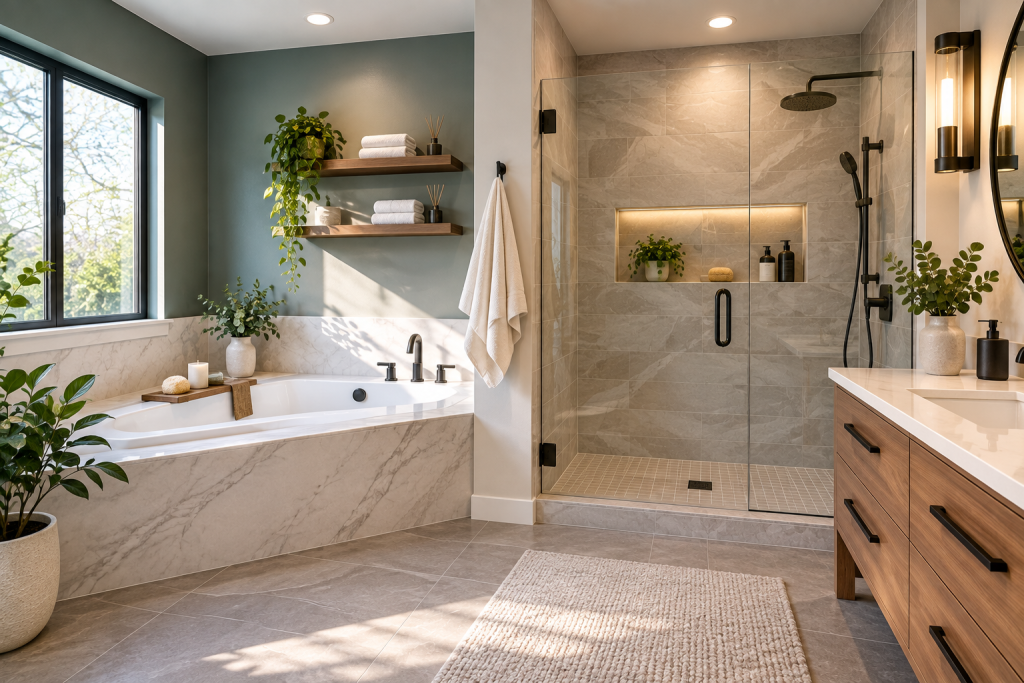
A partial bathroom remodel is often enough when most of the room still works and only a few areas need attention. A full bathroom remodel makes more sense when several parts of the space have problems, the layout no longer works, or plumbing, flooring, ventilation, or other hidden systems need attention.
The decision should not come down to how old the bathroom looks. A dated bathroom can still have a good layout and sound systems. A newer-looking bathroom can hide moisture problems, damaged flooring, poor storage, or plumbing issues. The best approach is to look at what works, what does not, and how closely the problem areas are connected. This guide will help homeowners decide how much remodeling their bathroom actually needs.
What Is a Partial Bathroom Remodel?
A partial remodel updates selected parts of the bathroom while keeping other usable features in place. For example, a homeowner might replace the vanity and flooring while keeping the existing shower. Another project may focus on a shower, new fixtures, or better storage without rebuilding the rest of the room.
Partial remodeling can range from a simple cosmetic update to more involved work. The key difference is that a significant portion of the existing bathroom remains. A partial project may make sense when the layout still works, major systems are in suitable condition, and the problem is limited to specific parts of the room.
By comparison, full bathroom remodeling considers more of the room together. That may include the bathing area, vanity, flooring, lighting, storage, fixtures, and other connected elements.
Planning Tip: Do not define the project by the number of items you want to replace. Look at how those items connect. Replacing a vanity and light fixture is very different from replacing a shower, flooring, plumbing, and damaged subfloor at the same time.
Full vs. Partial Bathroom Remodel at a Glance
There is no single rule that turns a partial project into a full remodel. This comparison makes the difference easier to understand.
| Decision Factor | Partial Bathroom Remodel | Full Bathroom Remodel |
| Main goal | Improve selected problem areas | Improve several connected areas |
| Existing layout | Usually remains | May remain or change |
| Tub or shower | May stay or be replaced | Commonly reviewed or replaced |
| Vanity | Optional | Often included |
| Flooring | May remain | Often included or evaluated |
| Lighting | Selected fixture changes | Broader lighting changes possible |
| Plumbing locations | Usually remain | May remain or move |
| Electrical work | Usually limited | May include broader updates |
| Hidden conditions | Can expand the project | Can be addressed within wider scope |
| Disruption | Usually lower | Usually greater |
| Best suited for | Bathroom mostly works | Several areas need improvement |
One important point is easy to miss: a full bathroom remodel does not automatically mean moving every fixture. A bathroom can receive new flooring, vanity, shower, lighting, fixtures, storage, and finishes while the main plumbing locations stay exactly where they are.
A Partial Bathroom Remodel May Be Enough If…
A partial remodel works best when the bathroom already has a good foundation and the new work can improve specific issues without creating problems elsewhere.
- The current bathroom layout still works well. The toilet, sink, bathing area, and storage are positioned comfortably, so changing the entire room would add work without solving an actual problem.
- Only one or two areas cause frustration. A worn vanity, dated flooring, or difficult-to-use shower does not always justify replacing every other part of the bathroom.
- The flooring is still in good condition. If there is no significant wear, moisture damage, or subfloor concern, usable flooring may remain while another part of the bathroom is remodeled.
- The existing plumbing locations support the new design. Keeping usable drains and water-supply locations can simplify a focused remodel when there is no reason to relocate them.
- Ventilation already works properly. A bathroom with good moisture control may not need changes to every system simply because finishes are being updated.
- You like the general layout but not the appearance. A vanity, countertop, hardware, lighting, or selected surface updates can sometimes change the room enough without rebuilding it.
- The tub or shower is the main problem. A damaged, outdated, or difficult-to-enter bathing area may be handled through a focused bathtub or shower remodel while much of the room remains untouched.
- Accessibility is the main goal. If stepping over a tub has become difficult but the rest of the bathroom works well, a tub-to-shower conversion may solve the most important problem without requiring a complete renovation.
- The items you plan to keep fit your long-term goals. A partial remodel works better when today’s improvements will still make sense if another part of the bathroom is updated later.
A targeted project can be a practical choice when it solves the actual problem instead of replacing usable features simply for the sake of replacing them.
Planning Tip: Before deciding what to keep, ask whether each existing component will still make sense five years from now. Keeping a good vanity is sensible. Keeping one you already plan to replace next year may lead to duplicate work.
A Full Bathroom Remodel May Make More Sense If…
A broader project becomes more practical as problems begin to overlap. The issue is no longer one old fixture. Several parts of the room may be limiting comfort, function, appearance, or future plans.
- Several parts of the bathroom no longer work well. Worn flooring, poor lighting, weak storage, an outdated shower, and an aging vanity together suggest a room-wide problem rather than one isolated repair.
- The current layout creates daily frustration. A crowded toilet area, oversized tub, awkward vanity, narrow walkway, or poor storage placement may require more than surface changes.
- Major plumbing changes are already planned. Moving a shower, vanity, or other fixture can affect walls and flooring. Once several areas are being opened, planning them as one remodel may make more sense.
- Moisture problems affect more than one area. Damaged wall materials, recurring moisture, deteriorated flooring, or subfloor concerns deserve attention before new finishes cover them.
- The ventilation system does not control bathroom moisture well. New paint and finishes will not correct an underlying ventilation problem.
- The bathroom was remodeled in pieces over many years. Different floor heights, mismatched fixtures, poorly coordinated finishes, or older repairs can make another isolated update harder to integrate.
- You want several major components replaced at once. A project involving the shower, vanity, flooring, lighting, storage, and fixtures may be more efficiently planned as a complete bathroom renovation.
- You are already opening several walls or sections of flooring. At some point, working around isolated old materials adds complexity rather than meaningfully reducing the project scope.
- Your household’s needs have changed. Better storage, easier shower access, clearer walking space, improved lighting, or a more functional layout may require the room to work differently as a whole.
Vision Sync Bath’s bathroom remodeling services can help homeowners consider the room as a connected space instead of treating every fixture as a separate decision.
Planning Tip: Do not automatically replace everything because the project has grown. Identify which existing features genuinely interfere with the new plan. A well-positioned toilet or functional plumbing wall may still be worth keeping.
The Gray Area: When a Partial Remodel Starts Becoming a Full One
Some bathroom projects begin small and gradually become larger.
A homeowner may initially plan to replace the shower and vanity. Then the old flooring no longer works with the new vanity footprint. Opening the shower reveals wall repairs. New lighting requires some electrical changes. Poor ventilation also needs attention.
At this point, the important question is no longer, “How many things are we replacing?”
It becomes:
Would preserving the remaining older areas actually save useful work?
The number of components matters less than how closely those components are connected.
A shower project that does not disturb the vanity, floor, or lighting can remain focused. A shower project that requires wall repairs, flooring changes, plumbing work, and ventilation improvements is a different situation.
What Does Your Bathroom Actually Need?
Use the problem itself to help determine the scope.
| What You Notice | Partial Remodel May Work When… | Consider Broader Remodeling When… |
| Old shower or tub | Rest of bathroom functions well | Bathing area is one of several problem areas |
| Dated vanity | Layout and plumbing still work | Storage and room layout are also poor |
| Worn flooring | Wear is mostly cosmetic | Moisture or subfloor damage exists |
| Poor lighting | New fixtures solve the issue | Electrical/layout changes are also needed |
| Limited storage | New vanity or cabinet solves it | Room configuration wastes usable space |
| Hard-to-enter tub | Shower conversion solves main issue | Other areas also restrict mobility |
| Dated appearance | Main systems remain sound | Visible finishes hide wider problems |
| Awkward layout | One small adjustment helps | Several fixtures need repositioning |
This is why seeing the bathroom as a complete system matters. The shower, flooring, vanity, plumbing, lighting, waterproofing, storage, and ventilation can affect one another.
Can You Remodel a Bathroom in Stages?
Yes. A bathroom can be remodeled in stages, but the stages should be planned before the first one begins.
For example, replacing a shower now and a vanity later may work well if neither project affects the other.
The opposite approach can create unnecessary work. Installing new flooring now and then moving a vanity or plumbing later may mean cutting, patching, or removing part of the new floor.
The same principle applies to walls and paint. Finishing a wall before completing planned plumbing or electrical work can mean opening that finished surface again.
A phased remodel should answer two questions:
What can be completed independently today?
And what future work could disturb it?
Planning Tip: Tell the remodeler about future plans even if those items are outside the current project. That information can influence today’s shower dimensions, flooring transitions, plumbing decisions, storage, and fixture locations.
Can a Partial Bathroom Remodel Turn Into a Full Remodel?
Yes. Hidden conditions can increase the project scope after work begins.
The area behind a bathtub or shower may reveal moisture damage. Removing flooring can expose subfloor problems. Opening a wall may reveal plumbing that needs repair. This does not mean every partial remodel will grow into a full project. It means homeowners should avoid assuming that every condition can be confirmed before demolition.
A good remodeling plan leaves room for decisions if hidden problems appear. This is especially important around wet areas because waterproofing, wall materials, drainage, and floor conditions all affect how the finished bathroom performs.
Does a Full Bathroom Remodel Mean Changing the Layout?
No. A full bathroom remodel can keep the existing layout.
If the shower, vanity, and toilet are already positioned well, leaving them in place may avoid unnecessary plumbing relocation. The room can still receive new fixtures, flooring, lighting, storage, wall finishes, shower materials, and a vanity while preserving an efficient layout.
Changing the layout makes more sense when the current one causes an actual problem. Examples include inadequate walking space, poor shower access, badly positioned storage, or fixture placement that no longer fits household needs.
Do not move plumbing simply because the project is called a full remodel.
What About Bathroom Remodel Permits in Broomfield?
Bathroom remodeling scope can also affect local permit requirements.
The City and County of Broomfield’s current homeowner guidance includes a Remodel/Basement Finish process and states that its 2024 Building Code update became effective on April 15, 2026. Broomfield also maintains separate requirements for licensed contractors performing remodeling work.
The exact permit and inspection requirements depend on what the remodel changes. Plumbing, electrical, structural, or other regulated work may affect what is required. This is another reason not to assume that “partial” automatically means no permits or that every full remodel follows the same process.
Before You Decide, Look Beyond What Is Outdated
The easiest way to overspend is to replace everything simply because the room looks old.
The easiest way to under-plan is to replace only visible finishes while ignoring connected problems. Start with what actually needs attention. If one area causes nearly all the frustration, targeted work may be enough. If problems extend across the shower, vanity, flooring, storage, lighting, moisture control, and layout, a broader remodel deserves consideration.
Vision Sync Bath’s full bathroom remodeling service is the more relevant next step when multiple parts of the room need coordinated work. For projects centered primarily on the bathing area, a bathtub or shower remodel may be the better place to start.
Frequently Asked Questions
What is considered a partial bathroom remodel?
A partial bathroom remodel updates selected areas while keeping other usable parts of the room. It may involve a shower, vanity, flooring, lighting, fixtures, or another limited group of improvements without rebuilding the whole bathroom.
Do I need a full bathroom remodel if my bathroom looks outdated?
Not necessarily. An outdated appearance does not automatically mean the plumbing, layout, ventilation, flooring, and other major parts need replacement. If those components still work well, selected updates may be enough.
Can I remodel only part of my bathroom?
Yes. Targeted bathroom remodeling can work well when the remaining features are in good condition and fit the new design. The key is making sure today’s changes will not conflict with future plans.
Can I remodel my bathroom in stages?
Yes, but the phases should be planned together. Each stage should be designed so future plumbing, flooring, vanity, shower, or electrical work does not require removing recently completed work.
Does a full bathroom remodel require changing the layout?
No. A full remodel can replace most major surfaces and fixtures while keeping existing plumbing locations if the current layout works well.
Can a partial bathroom remodel become a full remodel?
Yes. Moisture damage, deteriorated subflooring, plumbing problems, or other hidden conditions discovered during demolition can increase the amount of work needed.
How do I know whether I need a full or partial bathroom remodel?
Look at how many parts of the bathroom cause problems and whether those problems are connected. One isolated issue may support a partial remodel. Several functional, moisture, layout, plumbing, or finish problems may make a broader project more practical.
Plan the Right Amount of Bathroom Remodeling
The best bathroom remodel is not automatically the biggest project. A partial bathroom remodel can make sense when most of the existing room still works. A full remodel becomes more useful when several areas need to function differently or when the planned improvements affect one another.
Vision Sync Bath helps homeowners plan bathroom remodeling in Broomfield, CO based on the existing space and the changes the bathroom actually needs. Explore full bathroom remodeling, review options for a focused bathtub or shower remodel, or contact Vision Sync Bath to discuss the right project scope for your bathroom.